Showing posts with label Google. Show all posts

Google Webmaster Tools- 5 Ways to Use it for SEO and Traffic


5 Beginners Tips for using Google Webmaster Tools for Increasing Search Engine Traffic for Your Blog.

5 Most Useful Tips Regarding Google's Popular Webmaster Tool.

Google Webmaster is as one of the best SEO Tools for Webmasters and Bloggers alike.Read the 5 most Useful Tips Regarding Google's Popular Webmaster Tool.All over the Internet World, Google's Webmaster Tools is very popular web

10 Google Plus Tips to Increase Followers to your G+ Circles


Google plus now hugely popular among bloggers, webmasters, artists, marketers, and social media fans!


Google Plus finally has come in the social media race with likes of Facebook, Twitter, and My Space. Google + is expanding its presence with lighting speed across the world


You would not expect a common user using Google Plus like the way they use Facebook and Twitter to share

Top 10 AdSense Plugins for WordPress Blogs


AdSense on Wordpress Blogs: Best 10 Free Adsense Plugins to Put Google Ads on WordPress Blogs.


Free Download-Google AdSense 10 Best Plugins for WordPress Blogs Websites .


Like Search Engine Optimization, you need to perform 'AdSense Optimization' in order to maximize the revenue generated by Google AdSense ads on your blog or website.

If you are r5fn67nnnworking on WordPress CMS or

10 Basic Tips to Keep your Website Safe from Google Panda/ Penguin Updates


10 Simple and basic ways to avoid any penalty for your blog from any Google Algorithm Future updates ( Panda/ Penguin).


Panda Penguin SEO Tips


Best ways to Keep your Blog Safe and secure from any type of Google Panda or Penguin Updates


Last Updated- August 2017


Google Panda is a modification to Google’s search
algorithm which makes it possible for users to find content that is

How and Why to Use Google Trends Tool? 5 Benefits for SEO and Webmasters


Google Trends : One of the most used tools by bloggers, Webmasters, and website owners for SEO, Keyword research and search analysis.


5 Reasons Why Bloggers should use Google Trends Frequently!


Google Trends Blog Post is a new addition in the series of the articles related to Webmaster Analytics tools and resources. We have briefly mentioned about Google Trends in the blog post-

Top 25 Keywords- Highest CPC and PPC Words for Google AdSense and Adwords


Google keywords-List of Top 25 Highest Paid Google AdSense and Adwords Keywords-year 2016


25 Hot keywords on Google Adwords or AdSense-

The top 25 Highest paying keywords mentioned in this list of 25 top paying Google AdSense or AdWords keywords are based on the highest paying Google Ads for the year of 2015-2016.

If you own/run a website, write a blog, article or Lens, then

100 High PR Blogs to Get Free Backlinks with High Google PR & Top DA| Blog SEO Techniques


List of 100 High PR Blogs for commenting Dofollow free backlinks : Comment backlinks for SEO - Blog comment backlinks to shoot up search engine rankings of your desired keywords or blog posts?


After receiving a good response to this post- '30 blogs for dofollow comment backlinks' - i decided to publish this post which has much more number of Dofollow blogs for getting dofollow backlinks

Google Focused SEO Tips for Blog Writing- 10 Content Optimization Blogging Techniques


Understanding Basic Google Focused SEO Techniques - 10 Fundamental Blog Optimization Tips


We often include plenty of Google-focused Content optimization techniques in any SEO effort. Almost everyone knows some of the basic ways to do this, but some of the techniques may not be so obvious.


This a small guide or tutorial created for novice and intermediate bloggers. Some 8-10 blogging

USA Top 10 Social Networking Web Sites for 2014-2015


10 Best Social Media and Networking Websites for United States where you could spend your quality online time rather than being visible only on Facebook


With new social media platforms appearing every now and then, it is becoming hard for Americans to know exactly where to commit their time and resources. Don’t worry,
this article will give you the list of top 10 best social networking

Google plans to start sales of second-gen Nexus 7 tablet from July

Google Inc will launch a new version of its Nexus 7 tablet powered by Qualcomm Inc's Snapdragon processor around July, as the software giant pushes deeper into the cut-price mobile hardware market.


Google is aiming to ship as many as eight million of the Asustek-made tablets in the second half of the year, throwing down the gauntlet to other low-end tablets such as Amazon.com Inc's Kindle Fire and Apple Inc's iPad mini, the sources with knowledge of the new product said.


This is the first time details about the timing and sales targets for Google's new tablet have been unveiled, although the company has not publicly released any information.


Google, which gets almost all of its revenue from online advertising, wants the aggressively priced Nexus tablets to be a hit as more Nexus users would mean more exposure for Google's ads.


The latest version will have a higher screen resolution, a thinner bezel design and adopt Qualcomm's chip in place of Nvidia Corp's Tegra 3, which was used in the first Nexus 7s released last year, the sources said, declining to be identified because they are not authorized to speak to the media.


In a blow to Nvidia, Google weighed both U.S. chipmakers' processors but finally decided on Qualcomm's for power reasons, one of the sources added.


Qualcomm and Nvidia are competing aggressively in the tablet market as they seek to expand from their traditional strongholds of cellphones and PCs respectively.


A Google spokesman declined to comment on its new tablet. Qualcomm and Nvidia also declined to respond to questions.


Google and other traditionally non-hardware companies like Amazon and Microsoft Corp have begun making inroads into mobile devices as consumers increasingly access the Web on the go.


Google introduced its first tablet last June, hoping to replicate its smartphone success in a hotly contested market now dominated by Kindle Fire and iPad.


The Nexus 7 joined the ranks of smaller, 7-inch tablets popularized by Amazon and Samsung Electronics, among others.


Pricing is yet to be determined and Google's plans are fluid, the sources said. Market leader Apple is expected to launch new iPads this year as well, possibly forcing its competitors to change their assumptions.


Google may choose to sell the new gadget for $199, the same as the first generation rolled out last June, while the old model may be discounted, one of the sources said. Alternatively, the new tablet could be priced more competitively at $149 and the previous model discontinued, the source added.


The cheapest iPad mini goes for more than $300.


CORE STRENGTHS


Though pricing has not been finalized, discounting could play to Google's and Amazon's strengths by getting cheaper hardware into more consumers' hands to drive revenue from their core Internet-based businesses.


"This is the 'zero margin strategy'," said Fubon Securities analyst Arthur Liao. "Ninety-seven percent of Google's revenue comes from advertisement, so it needs to sell more mobile devices in order to reach more consumers."


The Internet search giant, which has never disclosed tablet sales, plans to ship six to eight million of the new Nexus 7s in the second half of this year, the sources said. That compares to an estimated 4.6 million Nexus 7s sold in the same period last year, according to Enders Analysis mobile industry analyst Benedict Evans.


The large volume could help to accelerate development of tablet-specific applications for its Android operating software.


Asustek, a netbook PC pioneer, will continue to co-brand with Google on the new Nexus 7. The Taiwanese company has said it aims to ship over 12 million tablets this year, almost double last year's shipments.

11 Security Holes Addressed by Google in Chrome 26

Chrome 26 is officially out and, as always, the latest stable channel update comes with a number of improvements in the security section. However, on this occasion, only 2 high-severity vulnerabilities have been addressed.
One of the high-severity flaws has been uncovered by Atte Kettunen of OUSPG. The expert has been rewarded with $1,000 (780 EUR) for a use-after-free issue in Web Audio.

By fixing the other high-severity bug, Google ensures that isolated websites run in their own processes.

Of the four medium-severity vulnerabilities, one – a use-after-free with pop-up windows in extensions – affects only the Linux variant.

Five low-severity bugs have also been identified.

Most of the issues have been found by the Google Chrome Security Team and members of the Chromium development community.

Subho Halder, Aditya Gupta, and Dev Kar, all three of xys3c, and “t3553r” have also been credited for finding security holes.

Pwn2Own ends with Oracle Java, Reader and Adobe Flash exploits

Day two of the Pwn2Own competition at CanSecWest was again successful for French Vupen security, as they succeeded in exploiting Adobe Flash on Internet Explorer 9 on Windows 7 by chaining together three zero-days (an overflow, a ASLR bypass technique and a IE9 sandbox memory corruption) and earning themselves another $70,000.

George Hotz exploited Adobe Reader XI (also on IE 9 on Win7), and Ben Murphy - the last contestant to target Java - has also managed to earn a prize even though he wasn't there, because James Forshaw, a winner from the previous day, agreed to serve as proxy and demonstrate the attack.

All in all, ZDI has awarded over half a million dollars in cash prizes and, of course, the compromised laptops and ZDI reward points.

The Google financed Pwnium hacking contest - also held at CanSecWest - this year requires contestants to "break" Chrome OS but has so far not witnessed a successful exploitation.

In the meantime, Mozilla has already fixed the use-after-free zero-day flaw exploited yesterday by Vupen Security, and Google has issued a Chrome update that fixes the flaws discovered by the MWR Labs team.

Google begins scanning of Chrome Extensions & Stops Auto-Install

Google has taken two steps to prevent its Chrome browser becoming an attack vector for malware that runs as extensions to the browser.

Like many other browsers, Chrome allows users to install “extensions”, apps that add functionality. Google even runs the “Chrome Web Store” to promote extensions.

Security outfit Webroot recently pointed out that some of the extensions in the store are illegitimate, data-sucking privacy invaders that trick users with offers to do things like change the colour of Facebook and then suck out all their data.

Google has responded in two ways, one of which is a new service “To help keep you safe on the web” that will see the company “analyzing every extension that is uploaded to the Web Store and take down those we recognize to be malicious.”

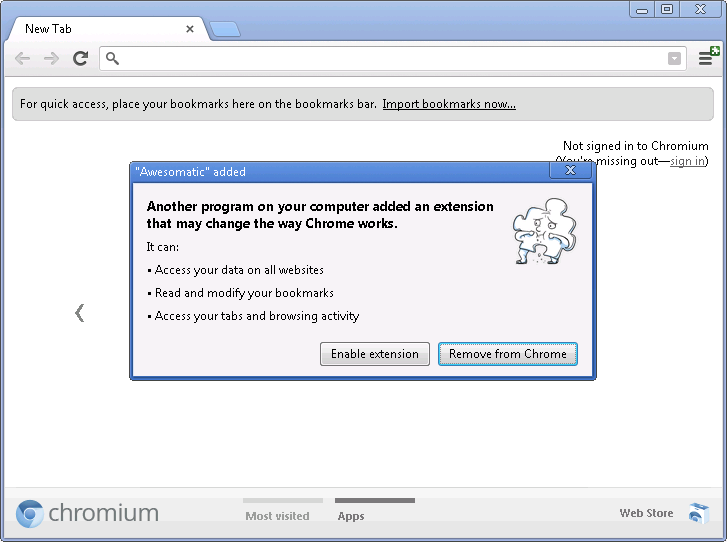
Changes are also coming in the forthcoming version 25 of the browser, which will no longer allow extensions to install without users’ knowledge. That’s currently possible because Chrome, when running on Windows, can is designed to allow unseen installs “to allow users to opt-in to adding a useful extension to Chrome as a part of the installation of another application.”

“Unfortunately,” Google now says in a blog post, “this feature has been widely abused by third parties to silently install extensions into Chrome without proper acknowledgement from users.”

Chrome 25 will therefore remove the auto-install feature, replacing it with a new system that presents the Windows Vista-esque screen below when extensions try to ingratiate themselves with the browser.


As ever, Google’s blog posts and support notice on the changes position them as responsible enhancements that show, yet again, Google is doing the world a favour.

A more critical analysis could consider the announcements in light of malware found in Google Play and take Google’s decision to more aggressively curate the Chrome Web Store as an admission it needs to devote more attention to this stuff, lest Chrome and other Google products become malware-ridden quagmires that users don’t trust.

Chinese government blocks Google.com, Gmail, Google+, Maps, Docs, Analytics, Drive, more


Google has experienced a precipitous drop in traffic from China, which a Web-monitoring group attributed to the search engine being "blocked" by the government.

Data provided by Google's Transparency Report shows a sharp drop off in traffic -- to roughly half the normal amount -- to Google's Web sites as of early this morning California time.

GreatFire.org, which performs real-time monitoring, suggested that the drop meant the Chinese government is "one step closer to fully separating the Chinanet from the Internet."

It wasn't immediately clear whether the block was intended to be long-lasting, or whether it's been lifted and Chinese Internet users will be able to connect to Google when they wake up. It's 3:50 a.m. in Beijing right now.

Google has been wrestling with censorship in China for more than half a decade. In April, Google Drive was blocked. Even after switching to a Hong Kong domain in 2010, sensitive topics remained off-limits.

Google has issued our representatives a statement today saying: "We've checked and there's nothing wrong on our end."

Google adds calculator to search results

Google has added a calculator to its search results.
Google has beefed up its built-in calculator function, adding an interface with 34 buttons. When a user types a sum such as "2 + 2" or "4 x 5," they are now confronted by the visual interface shown above — previously, Google would simply spit out the answer as text. The calculator includes functions for processing sines, cosines, and tangents as well as dedicated buttons for Pi and Euler's number and once the calculator is displayed, users can also tap numbers and scientific functions to send it a new equation. The company's search box will also still work.

Prior to this addition, Google allowed users to type into its search any equation. The search engine would then spit out the answer. However, this is the first time that Google has displayed an actual calculator its users can interact with.

Google Exploits Safari Flaw to Track Users Online

The Wall Street Journal has caught Google with its hand in the cookie jar of Apple’s Safari users, after manipulating Safari browser flaws to enable tracking users behaviours when browsing via cookies.


Search giant Google has been accused by the Wall Street Journal of bypassing the browser’s security settings by allowing a site to set tracking cookies.

Safari for Mac and PC, as well as Safari in-built into iOS devices, are thought to be affected. The browser was subject to tests by the Journal which show that Google used code in its advertisements to bypass Safari’s security, which by default blocks such tracking activity.

The aim of the code was to allow users who had signed into Google+ in Safari to access the ‘+1′ button within ads, provided by Google’s DoubleClick network.

“Don’t be evil,” the company said. While this may not classify as evil per se, it has already gained the attention of the online privacy advocacy group, the Electronic Frontier Foundation (EFF), reiterating the need for ‘Do Not Track’ rules on the Web.

Safari’s security would normally prevent ads from dropping a tracking cookie in such a case because it blocks cookies coming from advertising networks. But the code Google is accused of using ’tricked’ the browser into thinking the code was submitting a web form to Google; form cookies are not blocked, as it allows the browser to see whether the form was in fact sent.

The exploit isn’t new. It was first discovered in 2010 by Stanford researcher Jonathan Mayer and confirmed web developer and researcher Anant Garg.

But Google, while the biggest name on the list of the accused, was not the only one to do it. The Journal says that other advertising networks do similar things, such as the Media Innovation Group, Gannet’s PointRoll, and Vibrant.

Google’s DoubleClick adverts containing the privacy-circumventing code were found on major websites, including AOL.com, Match.com, TMZ.com and YellowPages.com, according to CNET reports. The Journal’s outside advisor found that 22 of the top 100 websites had Google’s Safari-busting tracking code, and that 23 different sites install the same code on Safari’s iOS browser.

The cookies were set to expire after 12 to 24 hours, but Safari can add even more cookies to a users’ browser once the first cookie as been left.

After Google was caught with its hand in the cookie jar, it said that “the Journal mischaracterizes what happened and why,” after it disabled the code. ”We used known Safari functionality to provide features that signed-in Google users had enabled. It’s important to stress that these advertising cookies do not collect personal information,” the company said.

Apple, however, was quoted as saying that it is “working to put a stop” to the circumvention of its privacy settings and security features.

Microsoft has weighed in, taking a cheap shot at its closest rival, by saying that “this type of tracking by Google is not new”. The Internet Explorer blog continued: “The novelty here is that Google apparently circumvented the privacy protections built into Apple’s Safari browser in a deliberate, and ultimately, successful fashion.”

Rachel Whetstone, senior vice-president for communications and public policy at Google, expanded on the Journal’s findings:

“Unlike other major browsers, Apple’s Safari browser blocks third-party cookies by default. However, Safari enables many web features for its users that rely on third parties and third-party cookies, such as “Like” buttons. Last year, we began using this functionality to enable features for signed-in Google users on Safari who had opted to see personalized ads and other content — such as the ability to “+1” things that interest them.

To enable these features, we created a temporary communication link between Safari browsers and Google’s servers, so that we could ascertain whether Safari users were also signed into Google, and had opted for this type of personalization. But we designed this so that the information passing between the user’s Safari browser and Google’s servers was anonymous — effectively creating a barrier between their personal information and the web content they browse.

However, the Safari browser contained functionality that then enabled other Google advertising cookies to be set on the browser. We didn’t anticipate that this would happen, and we have now started removing these advertising cookies from Safari browsers. It’s important to stress that, just as on other browsers, these advertising cookies do not collect personal information.”

Google will pay you $25 for your Web Privacy

google screenwise
The search giant is promising up to $25 in Amazon gift cards if you let it track the Web sites you visit and how you use them. Through a new project known as Screenwise, you install a browser extension that monitors every site you check out.

Google's stated goal is to find out how everyday people use the Internet in an attempt to help it improve its own products and services.

Those of you not shy about sharing your Web sites can score a $5 Amazon gift card when you sign up and download the Screenwise browser extension. You're then eligible for another $5 card for every three months that you stick with the program until the $25 max kicks in. However, the company is thinking about what further amounts it could add for people who last more than 12 months.

According to Google, "it's our way of saying 'Thank you.'"

To launch the project, Google is teaming up with Knowledge Networks, a company that rounds up panels of people to conduct online research.

To grab the deal, you have to be 13 or older, have a Google account, and use the Chrome browser. But before you try to jump on it right now, Google says it's already overwhelmed with interest and is advising people to come back to the Screenwise page at a later date for more details.

But apparently there's more to Screenwise than just the $25 browser extension project. A more extensive and expensive option asks you to set up a data collector router and then install the Chrome extension on each computer you use, says Ars Technica.

In return for collecting Web site data on every PC in your home, Google will pay you $100 just for signing up and $20 a month for as long as you participate, maxing out at a full year. Though similar to the $25 project, this one will look at different types of data.

Though Screenwise is strictly opt-in, the project comes at an odd time when Google is on the hot seat over changes to its privacy policies.

Top 10 Best Websites Globally for 2014-15 as per Alexa Rankings


What are the Top 10 Best Websites in the World for 2014-2015 as per Alexa Ranking ?


Alexa Top 10 websites for 2014-15- The list of Top 10 best websites 2014-15 is quite obvious for some, quite surprisingly shocking for others, but all the top 10 best websites in the world for the year 2014 as listed here are similar in one thing: they all have got top Alexa ranking, high Google PR,

Google Unveils Dart, an alternative to Javascript

dart-logo
Google today launched an "early preview" of Dart, a programming language the company hopes will help Web application programmers overcome shortcomings of JavaScript that Google itself feels acutely.

Programmer and project leader Lars Bak detailed the project in a talk today at the Goto conference conference today in Denmark and in a blog post. Dart is geared for everything from small, unstructured projects to large, complicated efforts--Gmail and Google Docs, for example.

"If we want to focus on making the Web better over time, we have to innovate," including with new programming languages, Bak said in an interview today.

Google also unveiled a Dart language site including open-source tools for writing Dart programs, code samples and tutorials, supporting libraries of supporting software, the Dart language specification, and forums for discussion.

Google is a big company, though, and others within the company remain strong JavaScript adherents. And Bak, while not denying Google has big ambitions, was quick to proclaim JavaScript alive and well.

"It's not going to replace JavaScript," Bak said. "JavaScript is is a cornerstone of the Web today, and it will continue to be for a long, long time."
Bak bristled at some of complaints about Google's approach to creating Dart in-house and not through a more collaborative approach.

"I don't buy the argument that before writing any line of code or designing any features, you put it in a standards committee, because that would just be a lot of screaming," Bak said. "You have to have coherent design before you start adopting Dart as a standard."
Making a standard is a goal, though. "It will be fairly lonely to create a standards committee when here's only us in it. We first have to get the backing of other partners before we can make a standard that's useful," he said.

Google is releasing Dart now for the next step in its maturation: outside feedback and participation. "We hope the other browser vendors will be excited," Bak said, adding that today is the first that Google has shared details about Dart with them or others.

Google is evaluating the best way to integrate Dart directly into its Chrome browser, something Bak is keen on. One reason: it will enable a "snapshotting" technology that dramatically improves a Web app's start-up time. Snapshotting involves taking an application and "serializing" it into a single block of data.

In one test of snapshotting, a 55,000-line Dart program loaded in 60 milliseconds compared to 640 milliseconds without it, Bak said. A conventional JavaScript program would load in comparable time as Dart without snapshotting, he said. "I can see a lot of optimizations that 'll be applicable to Dart" when it's integrated directly into a browser, he added.

Here's Bak's quick description of Dart:

Dart's design goals are:

• Create a structured yet flexible language for Web programming.

• Make Dart feel familiar and natural to programmers and thus easy to learn.

• Ensure that Dart delivers high performance on all modern Web browsers and environments ranging from small handheld devices to server-side execution.

Dart targets a wide range of development scenarios: from a one-person project without much structure to a large-scale project needing formal types in the code to state programmer intent. To support this wide range of projects, Dart has optional types; this means you can start coding without types and add them later as needed. We believe Dart will be great for writing large web applications.
Dart programs will be able to run within a Dart virtual machine--essentially a layer of software that acts as a computer to execute programs. They'll also be able to run using a compiler that translates Dart code into JavaScript code for browsers that don't support Dart, Bak said.

Google's Chrome browser has served as a vehicle to get the company's technology such as WebM and SPDY useful for at least a portion of Web users. Though the 2010 Dart/Dash memo said Google planned build Dart support into Chrome, Bak was cautious about making any definite statements beyond saying browser integration brings benefits. It's notable, though, that Bak led development of Chrome's V8 JavaScript engine, so he's hardly a stranger to the Chrome team or to the challenges of improving Web-app speed.

Building Dart into Chrome could let Google build Dart versions of its advanced Web apps that--if the language lives up to its billing--could be better than those Web apps today.

"Google has a lot fairly big Web applications. That includes Gmail and Docs. I hope many of these apps will be converted into Dart," Bak said--but cautioned that was his personal option, not an explicit plan.
Introducing new programming languages is tough. Though many hope that computing can improve by reforming or replacing languages, the incumbent power of existing languages is strong. Educating thousands or millions of programmers, building developer tools, and creating supporting libraries of code all can take years. As newer languages such as Java, JavaScript, and C# attest, though, it is possible.

Google also is trying to gain a foothold for Go, a programming language geared more for native software that today would most likely be written with C or C++.

Dart is designed to address several shortcomings Google sees with Web programming today, according to the Dart technical overview:

• Small scripts often evolve into large web applications with no apparent structure--they're hard to debug and difficult to maintain. In addition, these monolithic apps can't be split up so that different teams can work on them independently. It's difficult to be productive when a Web application gets large.

• Scripting languages are popular because their lightweight nature makes it easy to write code quickly. Generally, the contracts with other parts of an application are conveyed in comments rather than in the language structure itself. As a result, it's difficult for someone other than the author to read and maintain a particular piece of code.

• With existing languages, the developer is forced to make a choice between static and dynamic languages. Traditional static languages require heavyweight toolchains and a coding style that can feel inflexible and overly constrained.

• Developers have not been able to create homogeneous systems that encompass both client and server, except for a few cases such as Node.js and Google Web Toolkit (GWT).

• Different languages and formats entail context switches that are cumbersome and add complexity to the coding process.
The priority right now is to hear what the rest of the world thinks and to get them participating in Dart's development, Bak said.

"At this point it is mostly the language we are focused on," he said. "We hope to get positive feedback on the language."

Google Map 3D Now Shows You Helicopter View

Google is adding a new "helicopter view" option for directions in Google Maps, enabling you to see your trip from above in full 3D glory. Google is making use of its Earth view engine for this and it's a great way of both making people aware that they can see 3D content in Google Maps but also a way making trip planning more fun.

"Getting directions is one of the most popular features on Google Maps, whether it be for driving, walking, biking or transit," Paul Yang, a Google Maps engineer, wrote.

"Today, we are launching a new feature that allows you to bring your upcoming trip to life, by allowing you to preview your route in 3D," he announced.
The feature is now available to all users, but you need the Earth view plugin to make use of it. Enabling the feature is easy. Just plan out a route, like usual.

googlemap3d

You'll see the regular directions page, but there is now a 3D button next to the starting point. Hitting it will switch from the 2D map view to the 3D Earth view.

Then you'll be able to follow along as your trip is played back via the 3D engine. You can pause it at any moment and then move around, zoom in and check out the view from different angles.

You can also jump directly to another part of the trip by clicking on any step from the list on the left. Of course, once you're done, you can switch back to the 2D view by clicking on the 2D button.

The big caveat is that you have to install the Google Earth plugin for any of this to work. The plugin is available for most browsers on Windows, Google Chrome, Internet Explorer, Firefox, and Mac OS X, Google Chrome, Safari, Firefox. Linux users are out of luck.